Creating a memorial experience for Indonesia
Agni (hinduism): a Hindu and Vedic deity of fire
Through shared stories and memories, we hope to turn moments of grief into lasting expressions of love. Focused on creating a community platform for memorials, we can empower friends and family to come together, find closure, and honor the life of a loved one.
Mission overview
Zakki is an Indonesian social civic-tech NPO on a mission to build inclusive integrated communities for the marginalized through many of their projects, such as Agni.
Agni’s goal is to be developed as a progressive web app to help Indonesians from marginalized communities plan and arrange a funeral for the deceased, and to find emotional and financial support for it.
Design lead responsibility
My responsibility is to facilitate the product pipeline from research to design, while collaborating with stakeholders, and supporting volunteers' interests and expertises.
What we produced
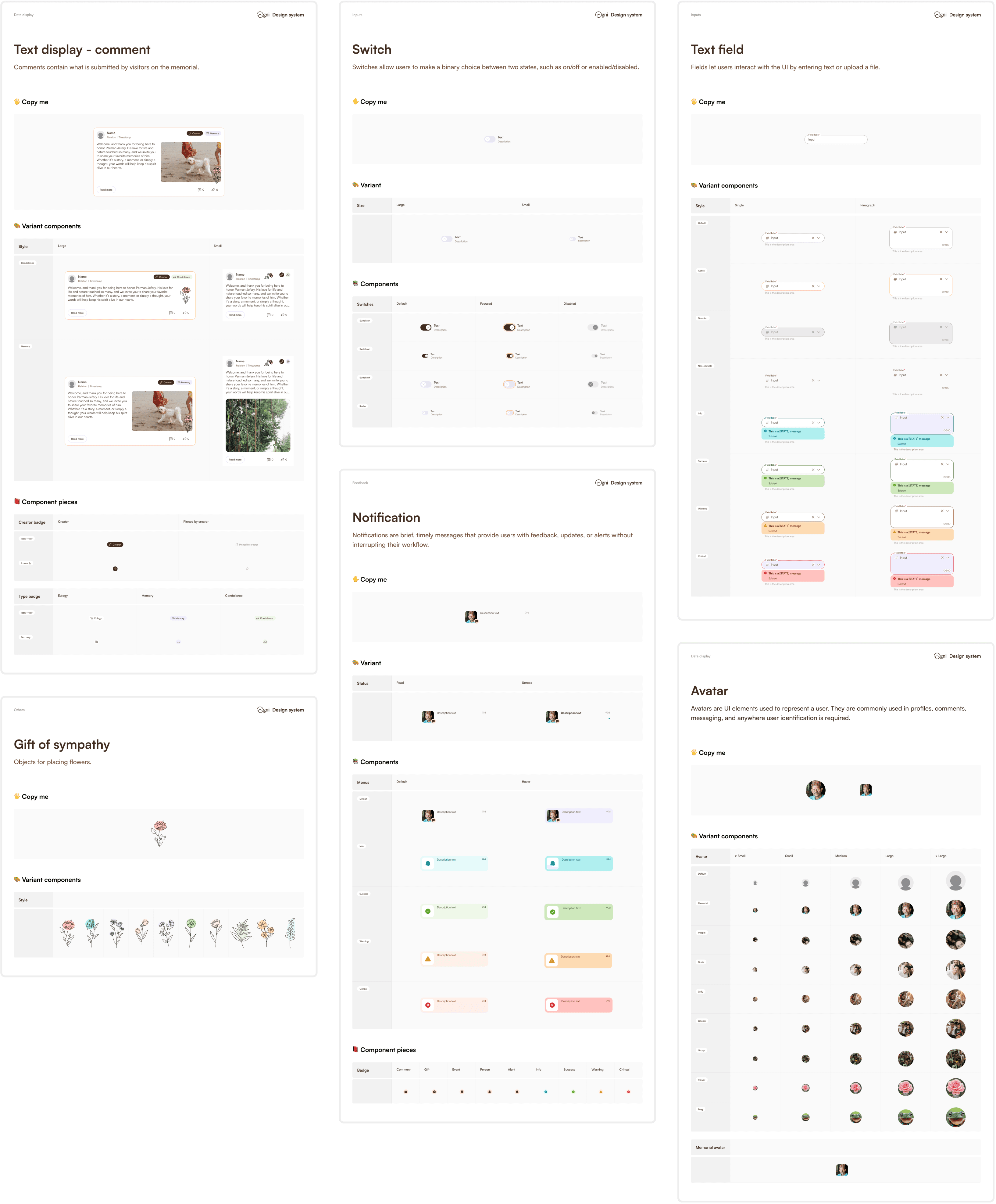
design system
visual style guide
MVP designs w/ upcoming features
Duration
2 years
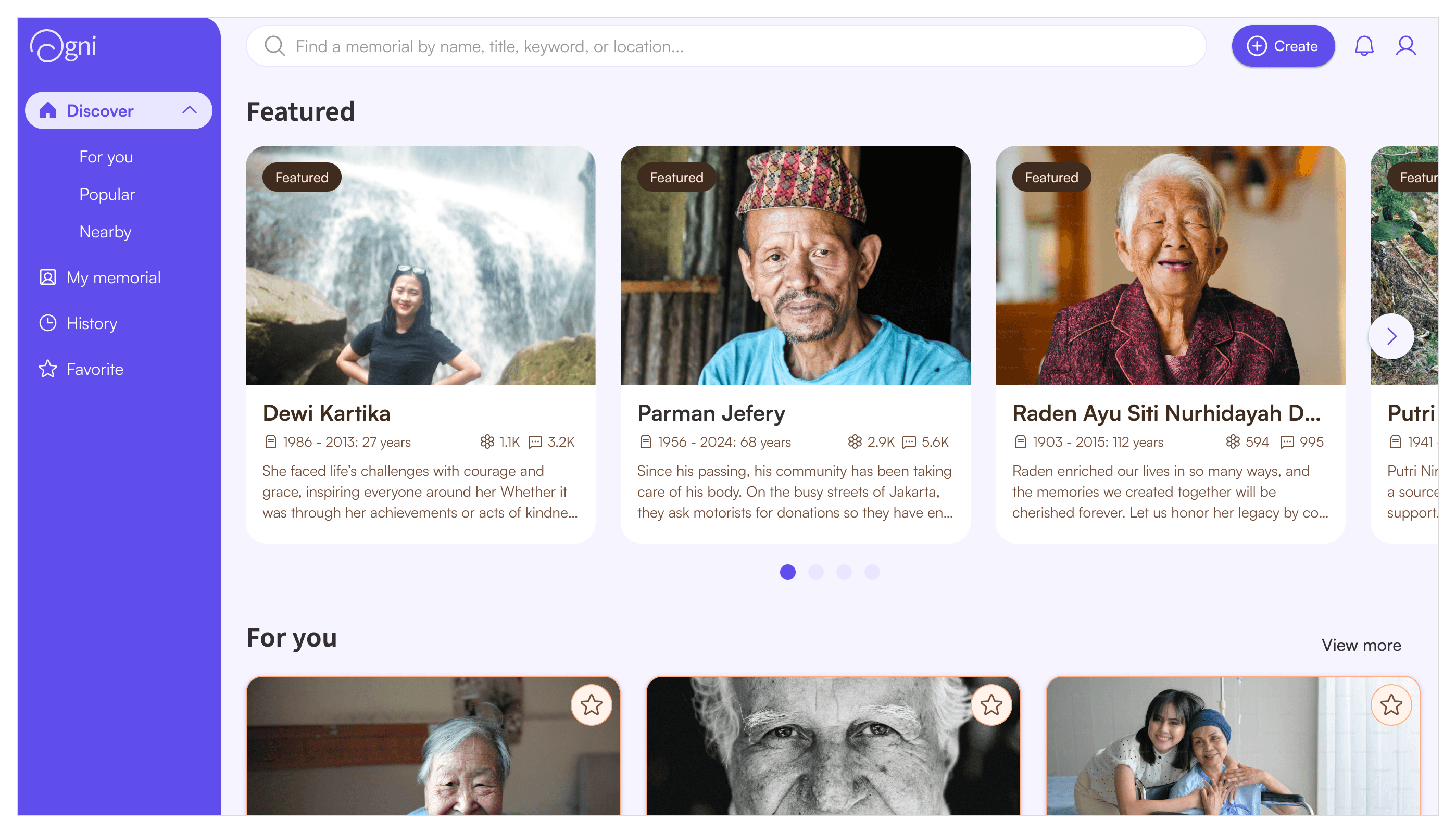
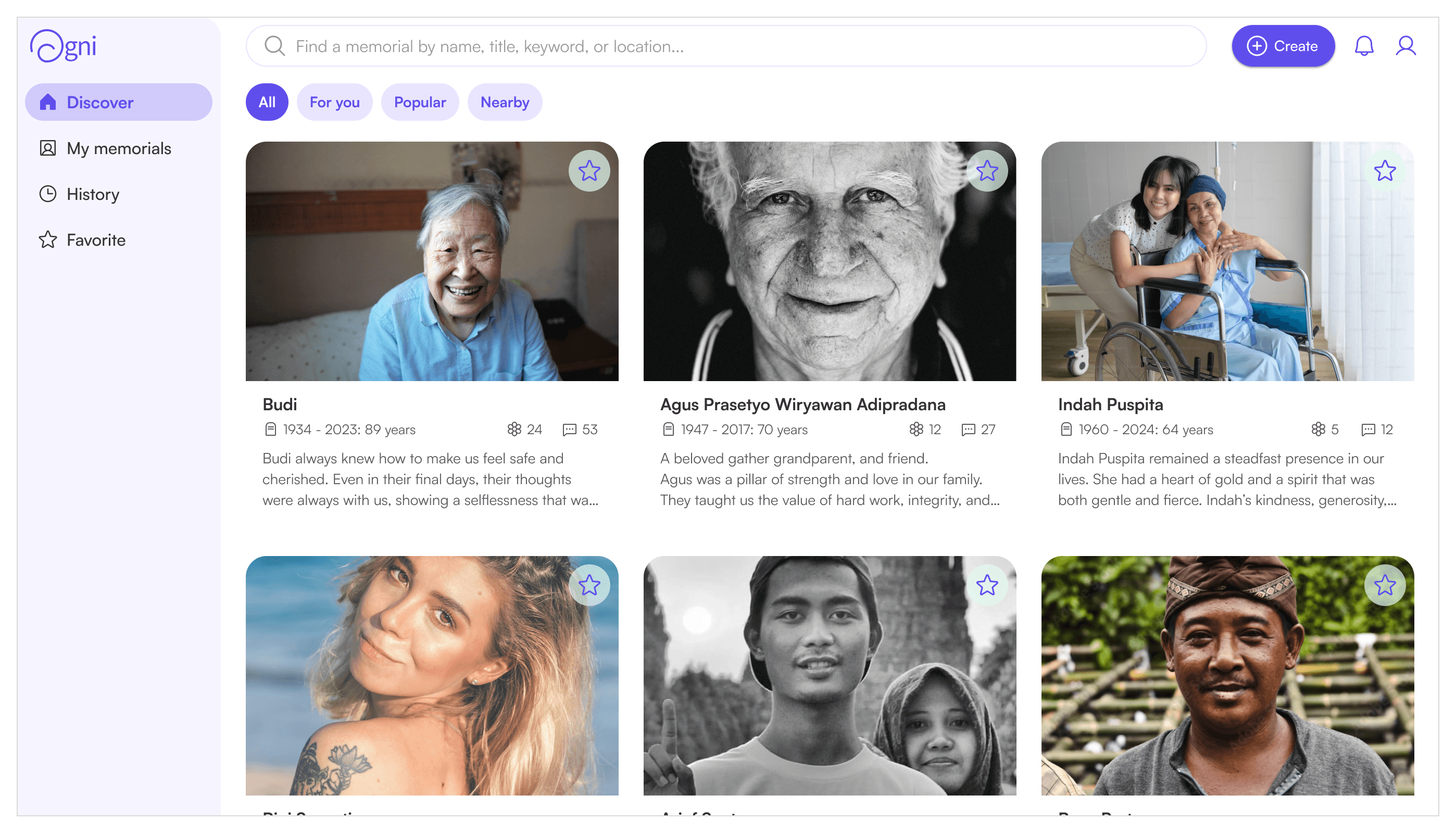
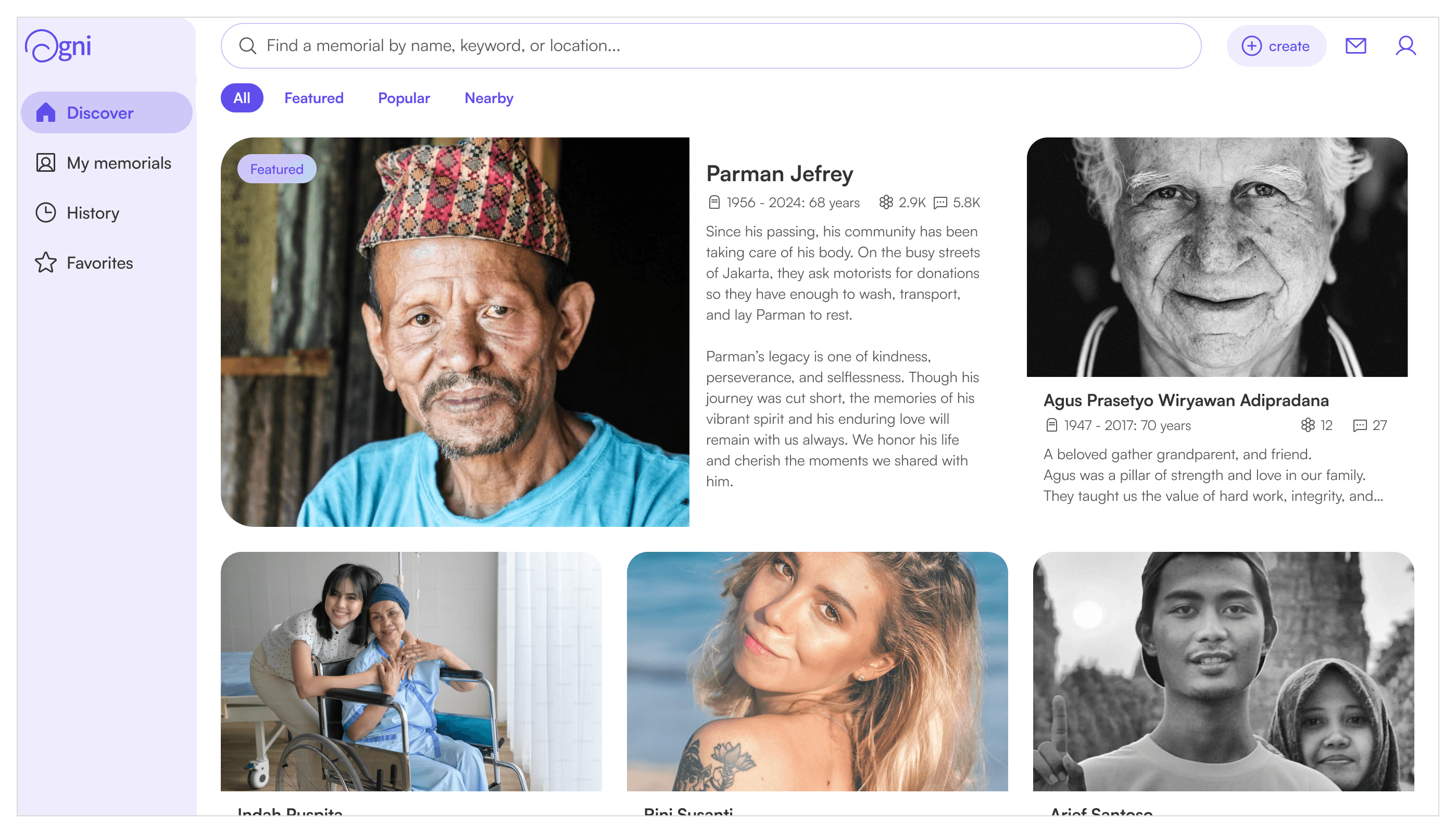
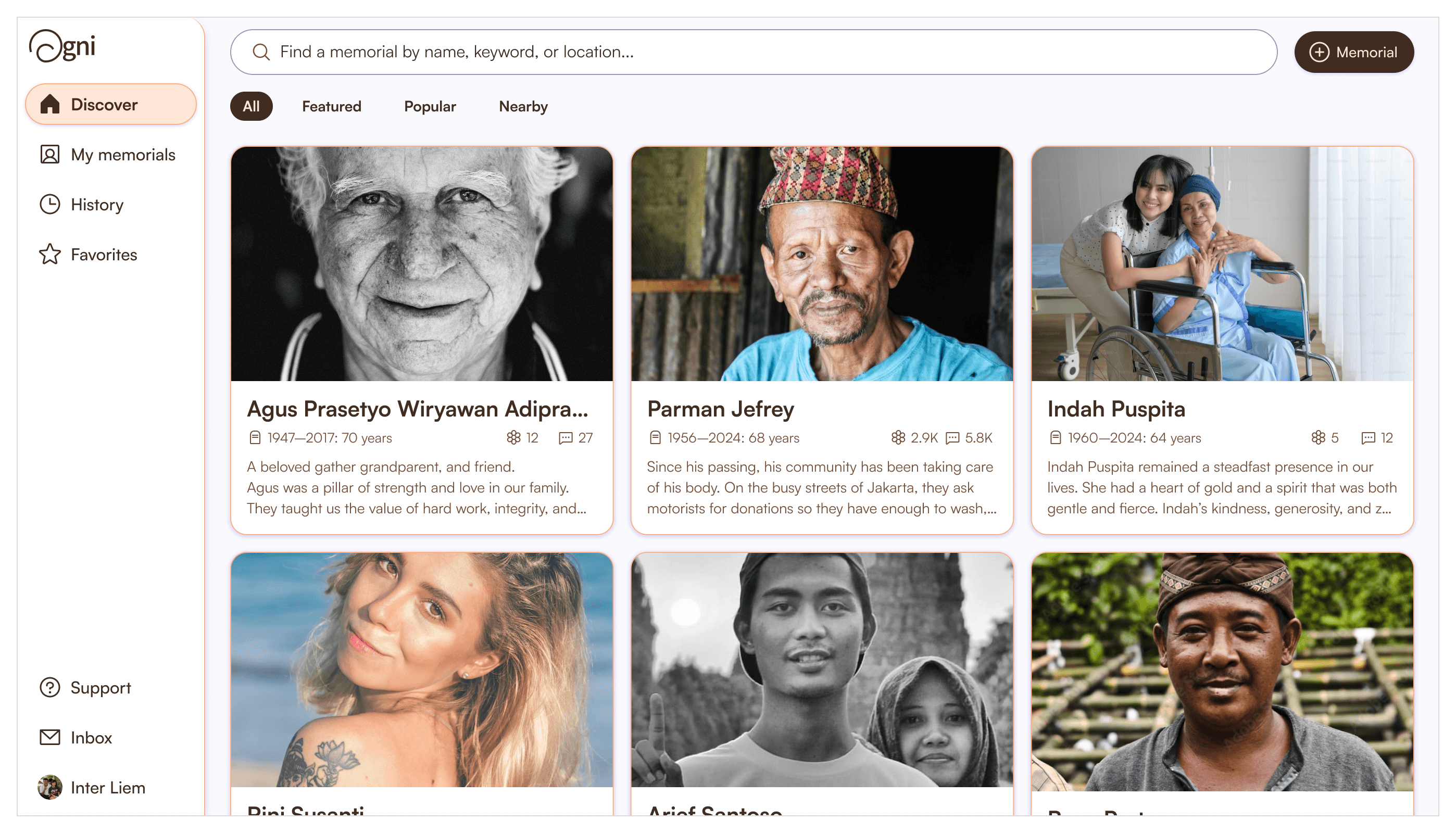
jan 2023 | initial findings
The problems & current solutions
Noted in 2019, Indonesia continues to face a shortage of burial spaces, particularly in densely populated cities, leading to rising costs due to scarcity.
Graves are rented; if not renewed, burial managers may rebury the prior deceased deeper to make room for the newly deceased. In Jakarta, grave rentals typically renew every 3 years.
Encouraging cremation is not a viable solution due to religious beliefs, especially for Muslims, who hold the largest religious population in Indonesia.
[2016] Parman, a street beggar
Parman passed away from an untreated illness. With no means to be buried, his friends covered his body and begged motorists for donations. With no ID or known details, seeking help was difficult, but his friends gathered enough funds to clean, transport, and bury him.
[2023] Their stillborn child
A grieving family faced tragedy when their stillborn baby was released to the father due to lack of funds for a burial. With no other options, he placed the baby in a freezer box. It was only when their story went viral that led them to garnering enough donations to bury their baby.
Discoveries & solutions
Version 1.0; Defining what that is
Our first step was our first blocker
Our project begun with a question: How might Agni provide the means to help users plan and arrange funerals? We recognized religion plays a major role in funerals practices, and Indonesia is a highly religious country. We started by exploring funeral traditions of the 6 religions Indonesia recognizes, only to discover that Indonesia is incredibly diverse in religion and rich in culture, with many local religious variations and customs.
Thoroughly understanding these practices to ensure Agni is accurate and respectful would require extensive online and in-person investigation—resources we don’t have. So, we pivoted from religion to investigating the emotional, social, and financial impacts of death.
Here’s what we discovered
Using affinity mapping to synthesize our results from surveys and interviews, we learned majority of participants...
are not confident with planning for a funeral
felt lost, and overwhelmed while planning for a funeral
struggled to cope with the emotional totality from the lost of a loved ones
felt financially burdened by the funeral
Exploring solutions
With a long list of ideas, I wanted to be mindful of resource constraints a non-profit would have. We narrowed down to 5 ideas, in which we wanted to empower grieving users with the ability to:
discover funeral related articles and resources
track funeral-related budgets, spending, and tasks
find grief support
communicate to their core group
request funeral donation
A solution
for everything
You may be thinking, “Wow that’s overloaded for MVP, and not realistic to develop for a volunteer project.” That’s what I realized as we worked on the user flows and wireframes. So, we revisited our discoveries to figure out what we can cut out, and realized that we were too focused on identifying the problems and did not see the solutions already in place:
Those who felt lost, and overwhelmed while planning for a funeral...
...turned to their community or religious center for guidance
Those who struggled to cope with the emotional totality from the lost of a loved ones...
...often felt supported by family, friends, and community
Except for...
Those who felt financially burdened by the funeral...
...continue feeling the financial burden of funerals, often times relying on donations or savings to cover funeral costs.
Refining Agni
Version 1.1; A pivot to crowd funding
With additional research, we know that dying is expensive:
For the Torajanese, an Indonesian ethnic group, the costs of their customary funerals are enormous that many families go into debt that would impact the generations to come.
BPJS Kesehatan (social security agency) cover most funeral expenses.
However, these programs face several complex challenges, especially for informal workers with irregular income.
By 2024, Indonesia achieved 96.4% registration of their population for Universal Health Care. However, 20% of registered participants have become inactive according to BPJS Kesehatan data, and are no longer making their monthly contributions.
While not from Indonesia, Alyce, an American-based funeral director we interviewed said something that resonated with us, “Funerals are not cheap. Dying is not cheap.”
Further research into Indonesian culture led us to...
Rukun Tetangga (neighborhood unit)
Rukun Tetangga (RT) is a volunteer-led village council, who takes care of community needs and facilitate activities.
RTs can help facilitate burials and funeral procedures, as well as collect jimpatan from the community.
There are many types of local governments in other regions with similar structures, but RT is going to be a starting point.
Jimpatan (a small pinch)
Jimpatan is a deep-rooted tradition of making a small donation to a community pot. It started off as a pinch of rice from every household that gets collected every month, and given to the most disadvantaged in the village.
Rice was eventually replaced with money because it was more efficient in meeting the needs of the underprivileged.
Digitizing a long standing tradition
Jimpatan is practiced in funerals to help with the cost of the funeral, burial, and post-funeral traditions. Every attendee is expected to contribute a small sum of cash. RTs will help facilitate burials and funerals, and help collect jimpatan.
Through creating a digital platform to collect jimpatan, we would provide another way for RTs, families, friends, and the community to virtually contribute, especially for those who have moved out of the village, or out of the country.
Addressing concerns from our Product Owner
During a design review conducted by the Product Owner, she expressed her concerns about fundraising platforms. She’s observed a lack of transparency on how the donations are used, and the lack of trust from the Indonesian public.
As per her recommendation, we researched and designed a reimbursement flow.
Designing to prevent misuse
With the reimbursement flow, we can potentially prevent misuse. Agni will withhold donations until receipts are submitted, reviewed, and approved. The campaign creator is then reimbursed for the verified amount. At the end, the campaign creator can choose another campaign to donate any excess.
TLDR:
1.
Users create a crowd funding campaign
2.
Donations received are withheld by Agni
3.
Users would upload receipt to file reimbursement claim
4.
Agni will review and verify reimbursed amount
5.
Users can donate excess funds to another campaign
Dec 2023 | Proposal to pivot
Version 2.0; Roadbump!
Taking a big step back
Our former project manager stepped down and was replaced by our current project manager. After a review on current design and research, he questioned the :
Market saturation
How is Agni going to compete against mature crowdfunding platforms such as Kitabisa, Mandiri Kita and GoFundMe?
Discoverability
How are potential campaign owners and donors going to discover Agni?
Motivation
Of these potential donors, how likely are they to continue donating?
Engagement
How many potential donors would be interested in donating to funerals for individuals that are not family or friends?
Reimbursement
Is it efficient for Agni to develop software that is already a standard business process?
and technically......
We didn’t have a plan for how Agni would help marginalized communities.
The pitch
Have you looked into obituaries?
Our project manager proposed expanding fundraiser pages to resemble obituaries. Instead of having traditional fundraisers, he hypothesized that an indirect approach to streamlining funds would be more effective at impacting those who disadvantaged.
“Why obituaries?” we asked.
Our PM reminisces about the days when local newspapers were a staple of the morning routine, always turning to the obituary section to see who in the community had recently passed.
Obituaries serves as an announcement of passing, typically with the date and time of the service. If you’ve lost someone you knew, chances are you’ve come across their obituary online.
supporting research
Does Indonesia use obituaries?
Conducting market awareness
Discussing experiences with death and gathering opinions on obituaries from Indonesians, our Indonesian UX researcher translated the transcripts and synthesized the results. We learned that:
It is common practice for catholics to use obituaries.
Mosques announce deaths within the community, but obituaries are not commonly used.
In-person grave visitation is preferred as the way to pay respects, negating the desire for a digital obituary.
Obituaries
We concluded that the concept of obituaries isn’t widely known or commonly used in Indonesia, and is more of a western concept. However, after reading their experiences we realize there was a pattern for how people remembered their deceased loved ones, and the barriers they faced in doing so.
All the memories I had with my aunt was always a collective memory that I shared with the rest of my family.
Akila
I used to reminisce about my aunt a lot, through images in my phone..I kept most of my digital images in google drive.
Luisa
My relationship with my grandma is close but not personal.. because of the language barrier… she doesn’t speak Indonesian… only my mom and her siblings would understand.
Juan
With my colleague he didn’t manage to visit any yet because his friends are buried outside of town that is even further, because of traffic.
Ari
Shifting our focus to memorialization, we saw the potential for Agni to:
Reconnect generations
The younger the generation, the more they are disconnected from their family history. Often times, stories of the older generation are remembered and shared by others.
Overcome barriers
Because of the distance or traffic, it is increasingly difficult for Indonesian people to travel and visit the deceased, especially on national holidays.
Unite communities
By empowering families, friends, colleagues, and the community, they would with the ability to collectively share memories and stories of the deceased.
Be another option
As a digital space to remember the deceased, an online memorial would be an alternative option for those who want a dedicated space to be remembered at.
competitive analysis
Why build one more?
Going against the common architecture
Memorial competitors rely on users to know exactly who they’re searching for, while their homepages serves as marketing for their services and features. By putting relevant memorials in the forefront, Agni can focus on connecting users with their community.
Other sites
Home page
Hero section
Call to action
How it works
Testimony
Pricing
FAQ
Online memorial
Eulogy
Condolences
Photos
List of life events
etc.
Agni
Home page
List of memorials
Online memorial
Eulogy
Condolences
Photos
Memories & stories
Upcoming events
Garden of flowers
[side quest] Should we implement Generative AI in online memorials?
During this time, AI tools were rapidly gaining traction, and we observed some of our competitors implementing generative writing features. Because of that, we wanted to explore the possibility of using generative AI to determine whether we should design for it.
How can we redefine remembrance with AI?
Imagine creating a memorial for a loved one and discovering a tools that:
helps craft their eulogy
generates meaningful cover images
creates virtual graves and props for visitors to interact with
This is why we want to explore how generative AI can enhance online memorials and make remembering more personal and interactive.
Assessing the feasibility
I was responsible for exploring the feasibility of image generation, while our PM focused on generative text. Building on his results, I conducted experiments to assess how well models could generate visuals.
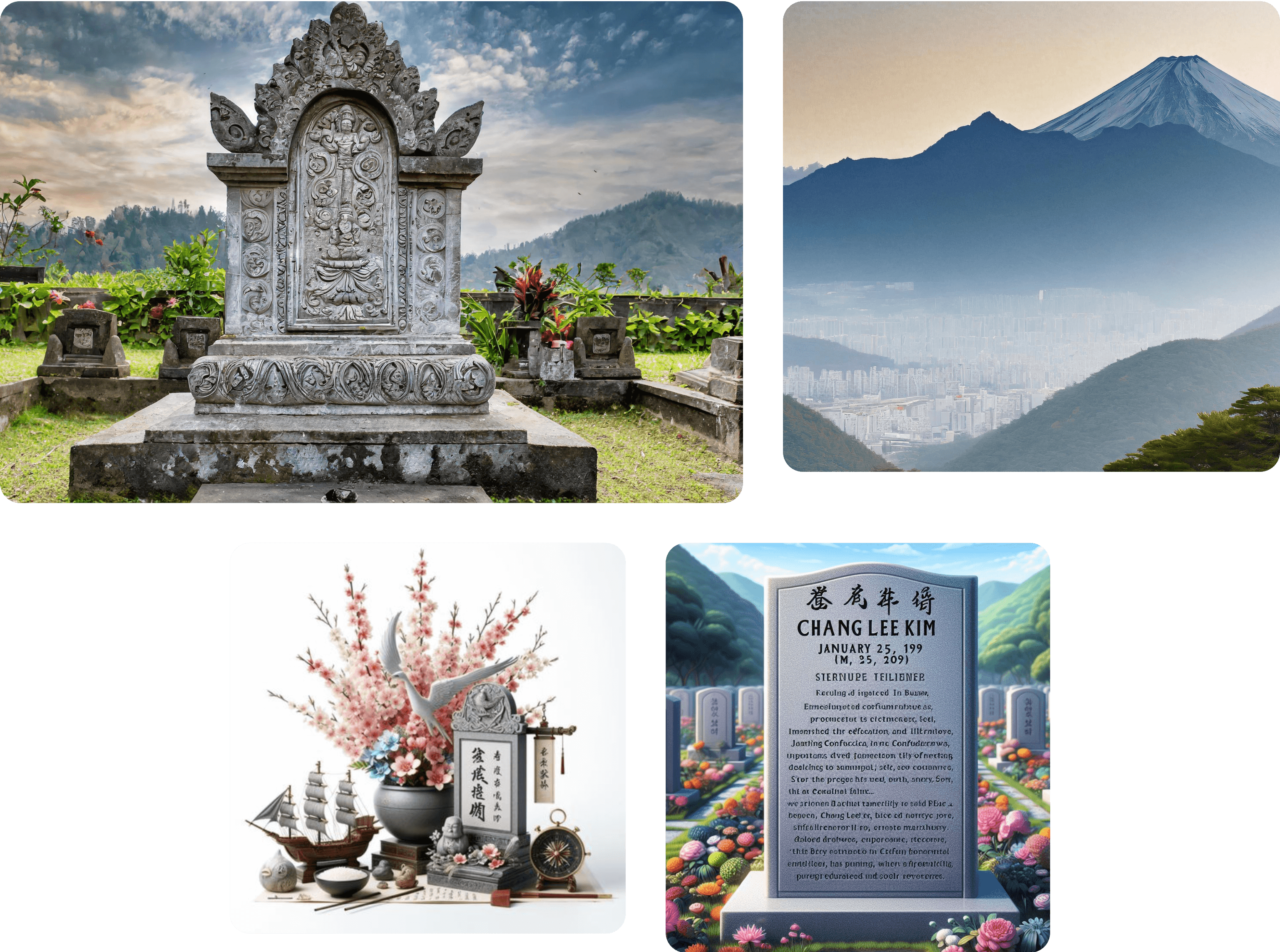
I tested multiple image generation models, including Microsoft, Adobe, and DeepAI, to determine their ability to generate the following subjects above.
Challenges in image generation
While text generation proved successful and relatively consistent, image generation faced several challenges, such as generating:
incorrect geological monuments, like Mount Fuji in Korea
fake words, even when explicitly instructed to omit
vague and messy depictions of religious figures
Because of this, we concluded that generative AI isn’t the right direction for now, as its inaccuracies could negatively impact the memorial experience.
The vision
version 2.1; A community of memories
Bringing up old memories
Our PM recalls the passing of his late father. Despite the announcement and obituary listing, friends and family reached out months later, shocked to hear the news too late.
Focusing on local and relevant memorials to the user, we aim to be an alternative way to receive news of a passing. The future of Agni would serve as a platform that extends the reach of memorials and can ensure no loss goes unnoticed. We hope to create a space where friends and family can find closure and healing through sharing memories and stories of their loved ones. After all, “what is grief, if not love persevering?”
On Agni, users can:
create a free memorial
write messages of condolence
share memories and stories
share upcoming memorials
send a flower to place in the virtual garden
We understood our users' pain points, but...
We hadn’t defined how to address them in a way that also met our business goals. We revisited the questions our PM asked in the beginning, had many discussions and debates on the product direction, decisions, and potential technical constraints, and we narrowed down to these ideas below:
How might Agni attract prospective users onto the platform?
open-access webapp
hub of community-created memorials
free customizable memorials
How might Agni retain user engagement?
foster community connection
personalized recommendations
notifications
enable user interactions
How might Agni be financially sustainable?
micro-transactions
freemium plans*
organization accounts*
vendor marketplace*
*in the future
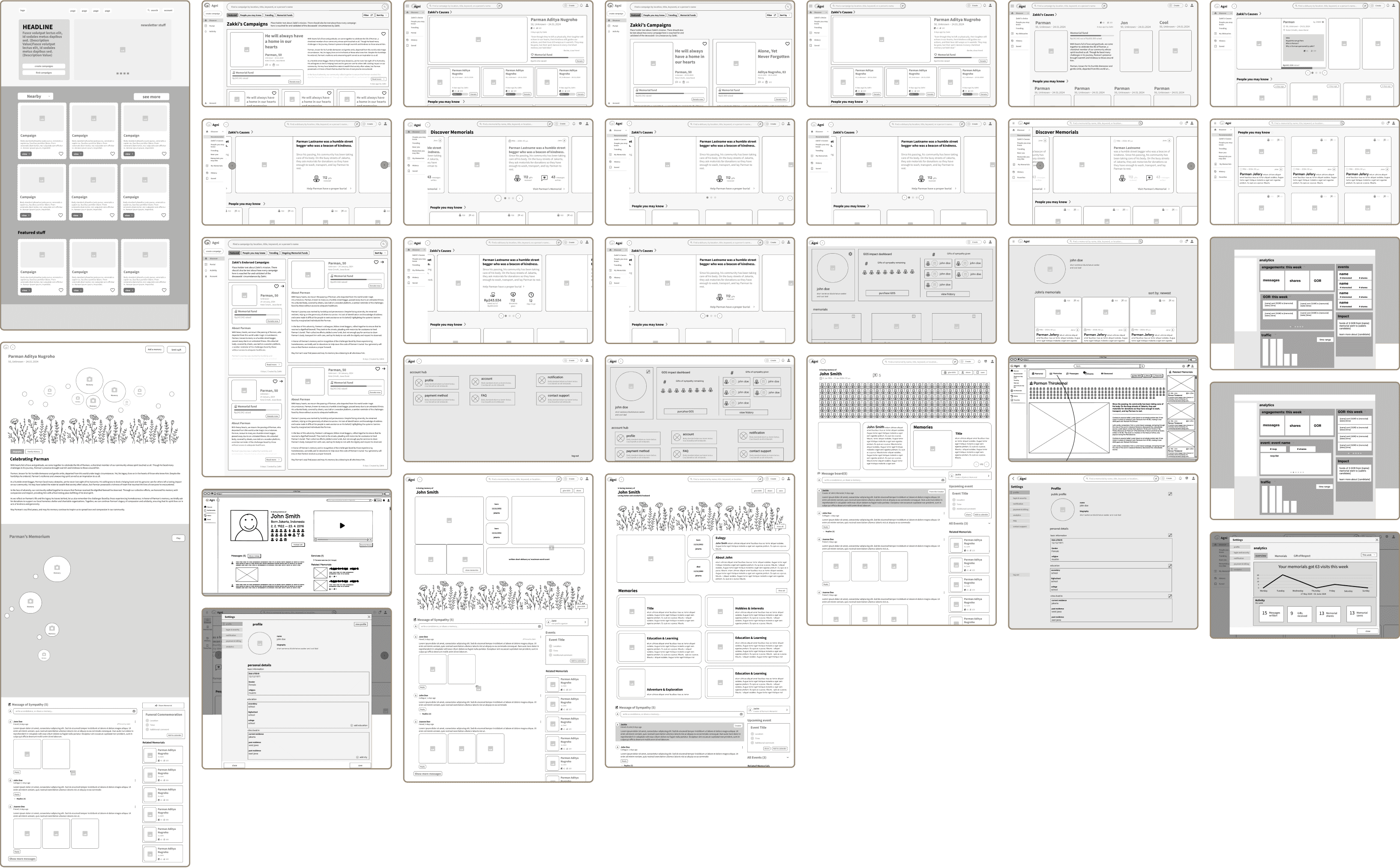
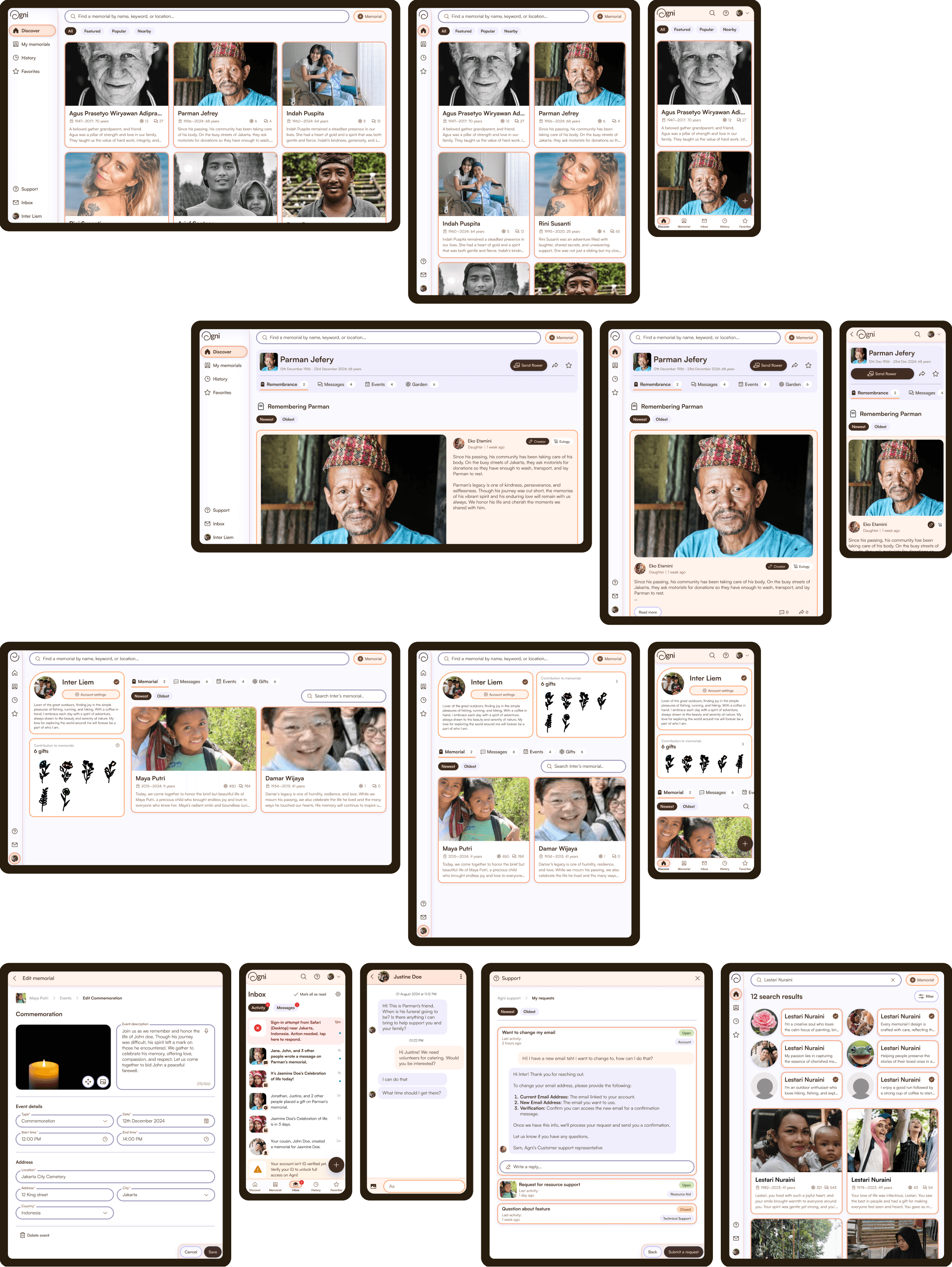
In tandem, we created maaany wireframes
Design guidelines
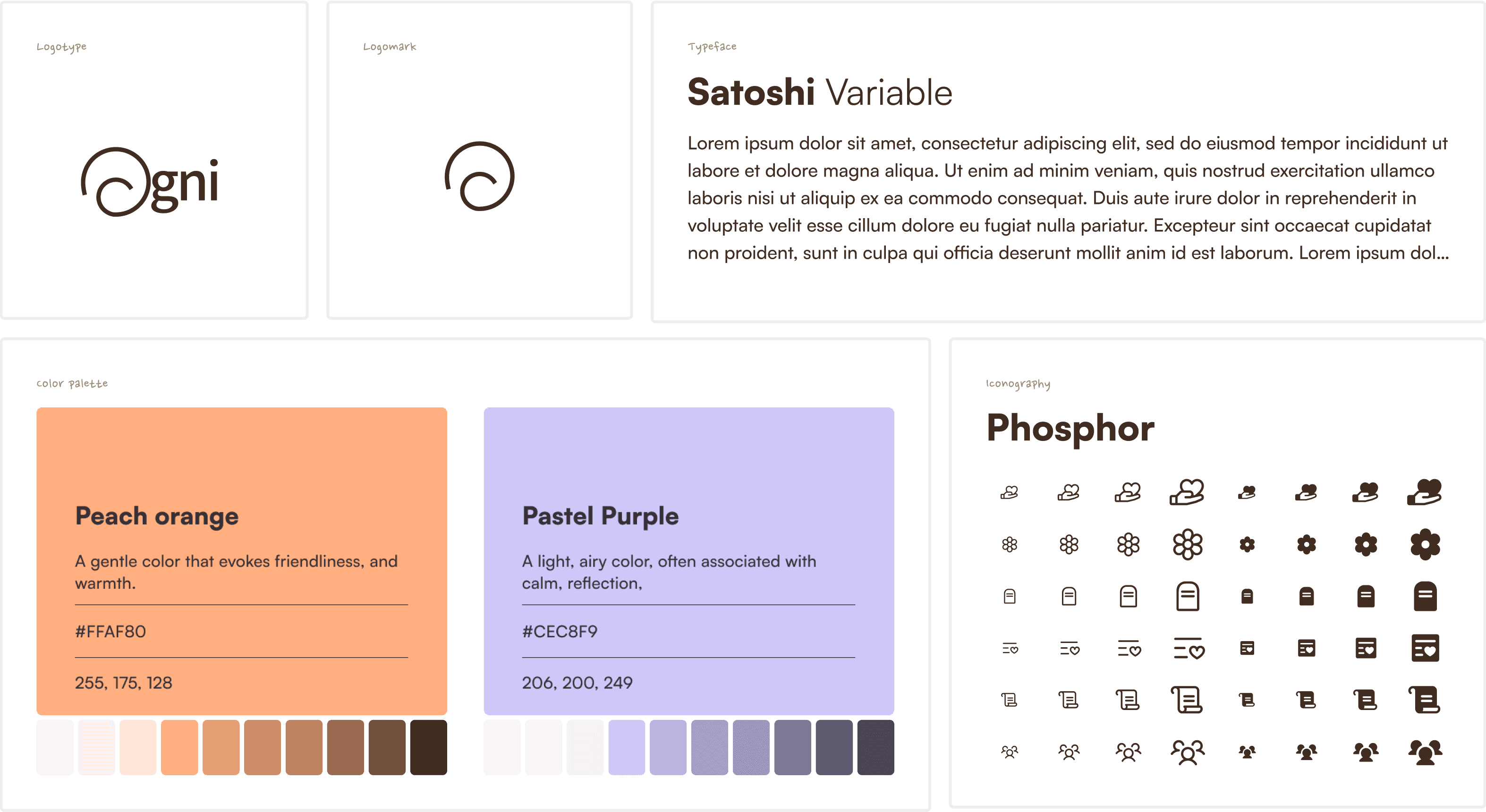
I took over defining the visuals
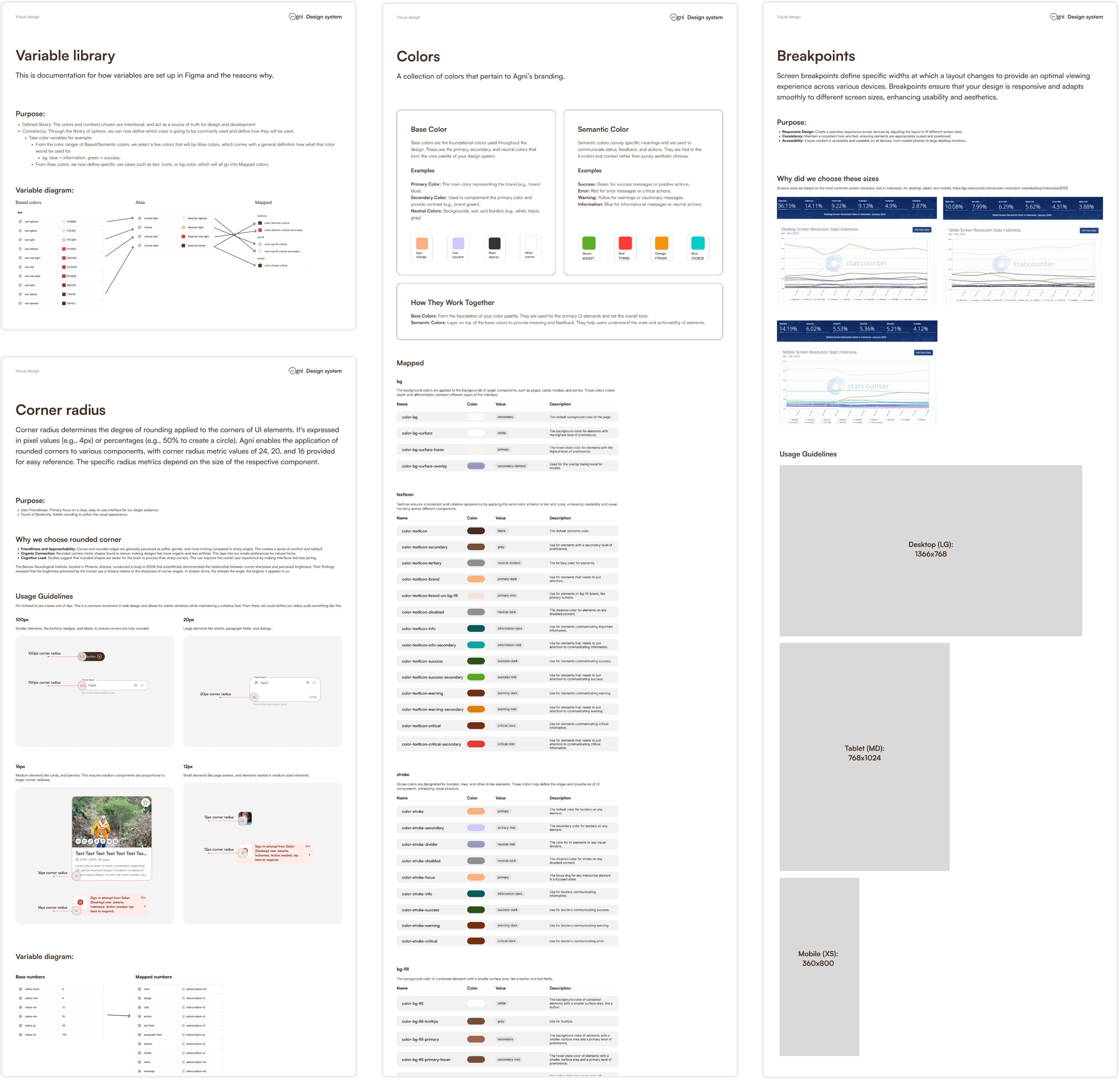
visual design
Adding color to Agni
Iterations didn’t stop at wireframes
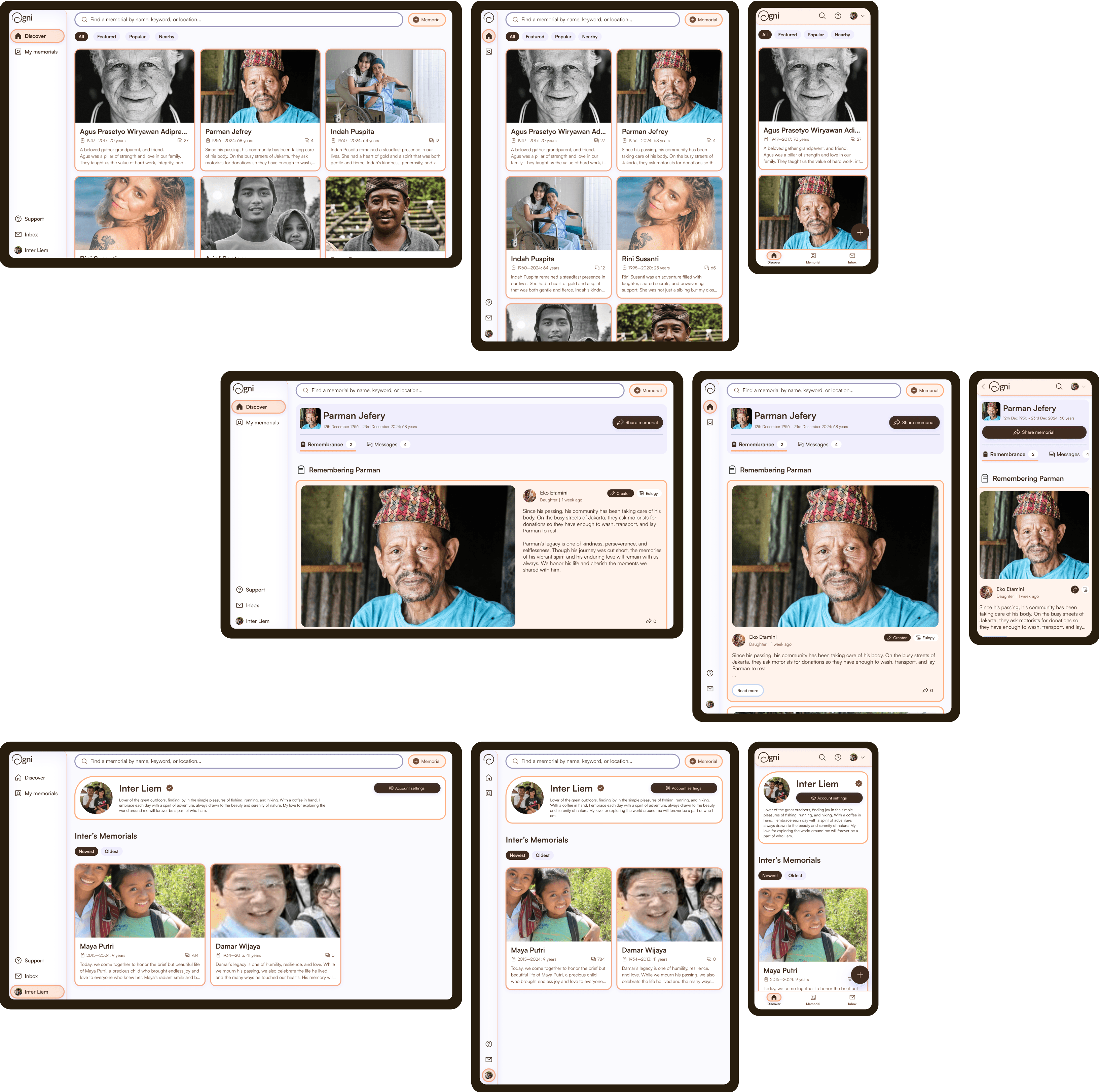
Designing across desktop, tablet, and mobile revealed many constraints, but we had time to solve them. After multiple reconfigurations, Agni was refined into 7 core features and 345 screens.
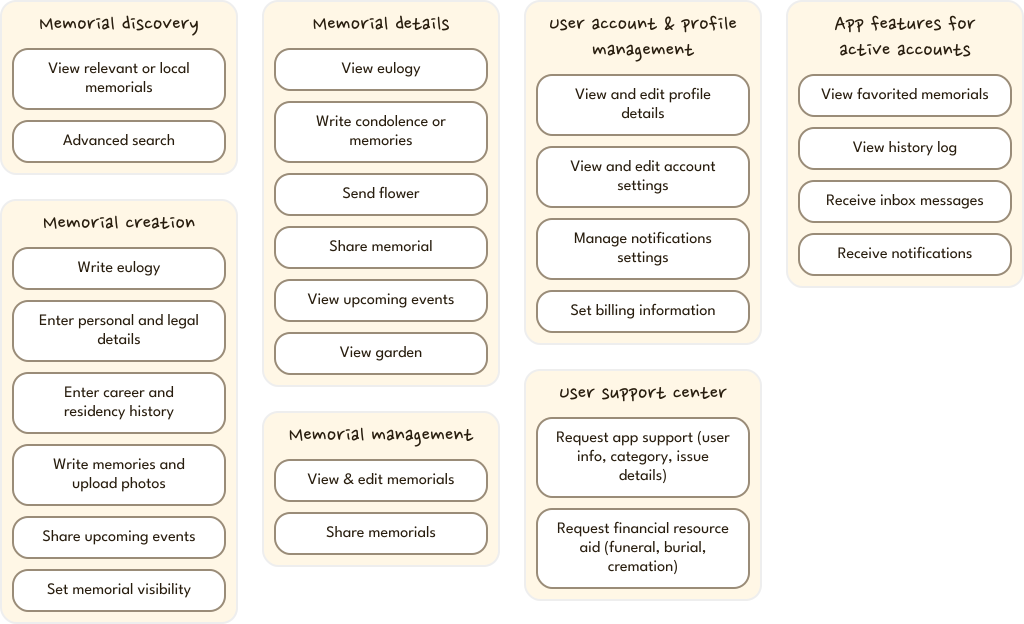
A few visual design screens
The business
Agni’s business strategy
How will Agni garner traffic?
We enabled sharing on nearly every aspects of a user’s interaction. Through social sharing, we can spread awareness, expand visibility, and drive traffic back onto Agni.
How will Agni engage with their users?
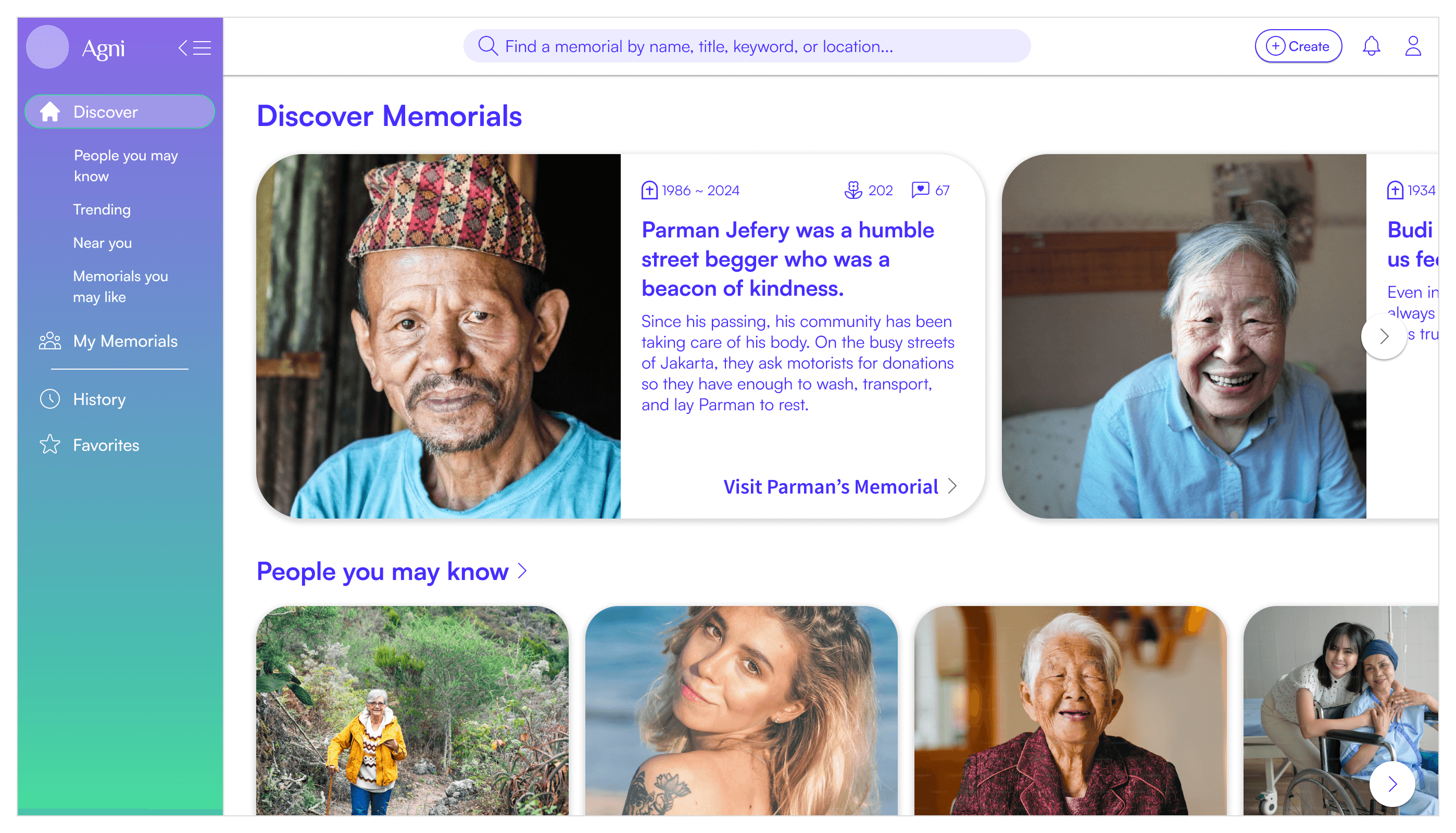
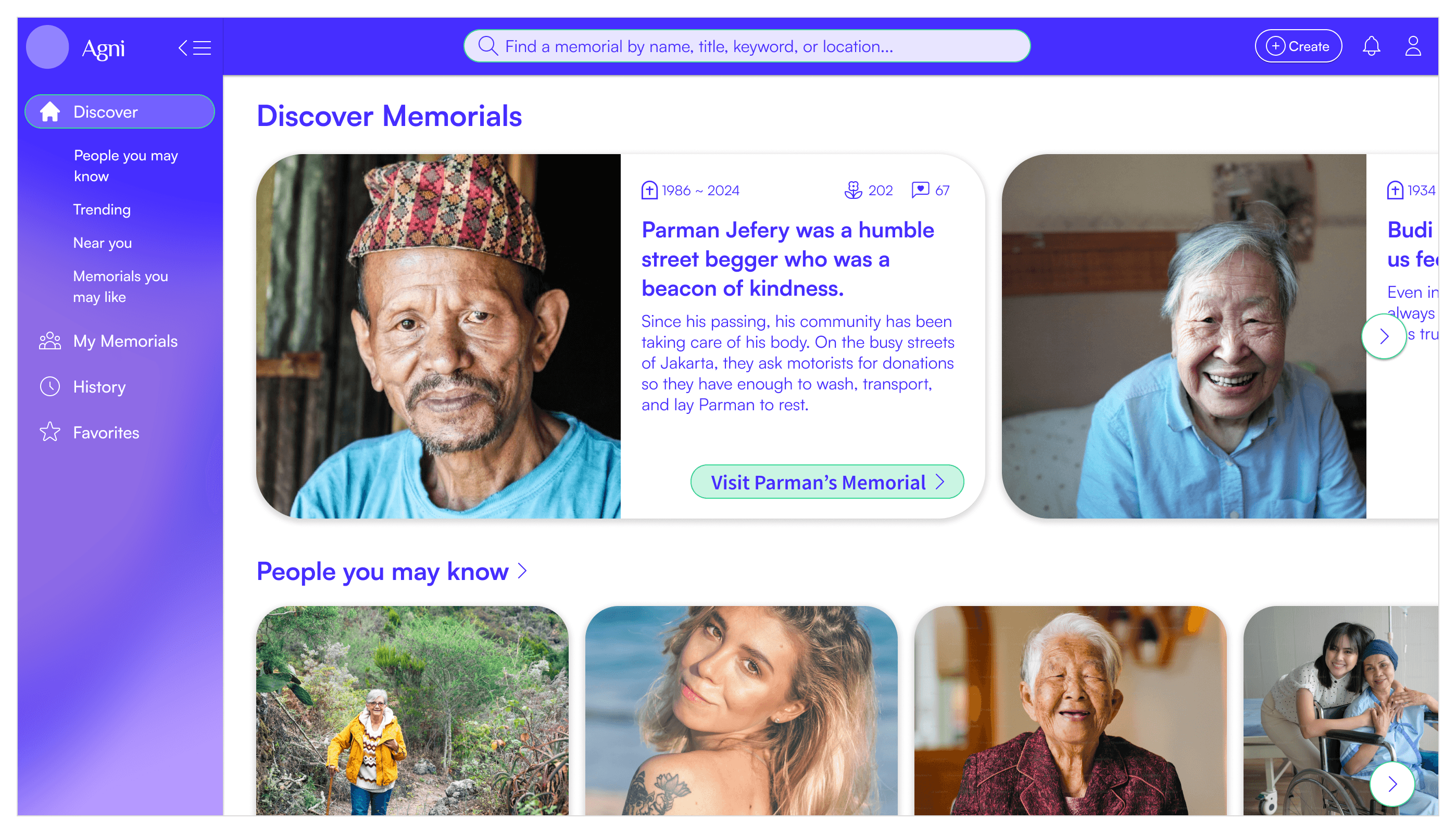
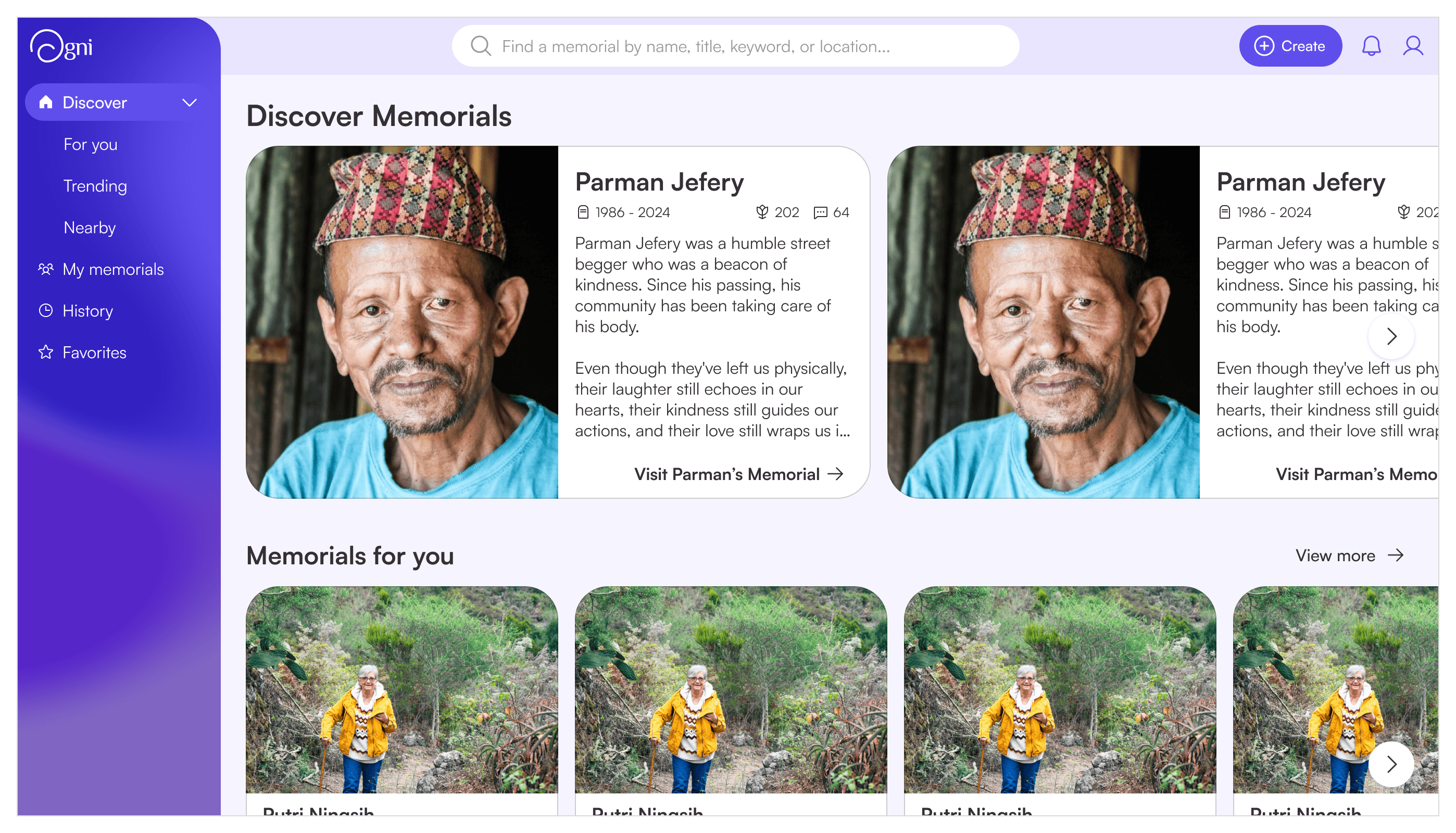
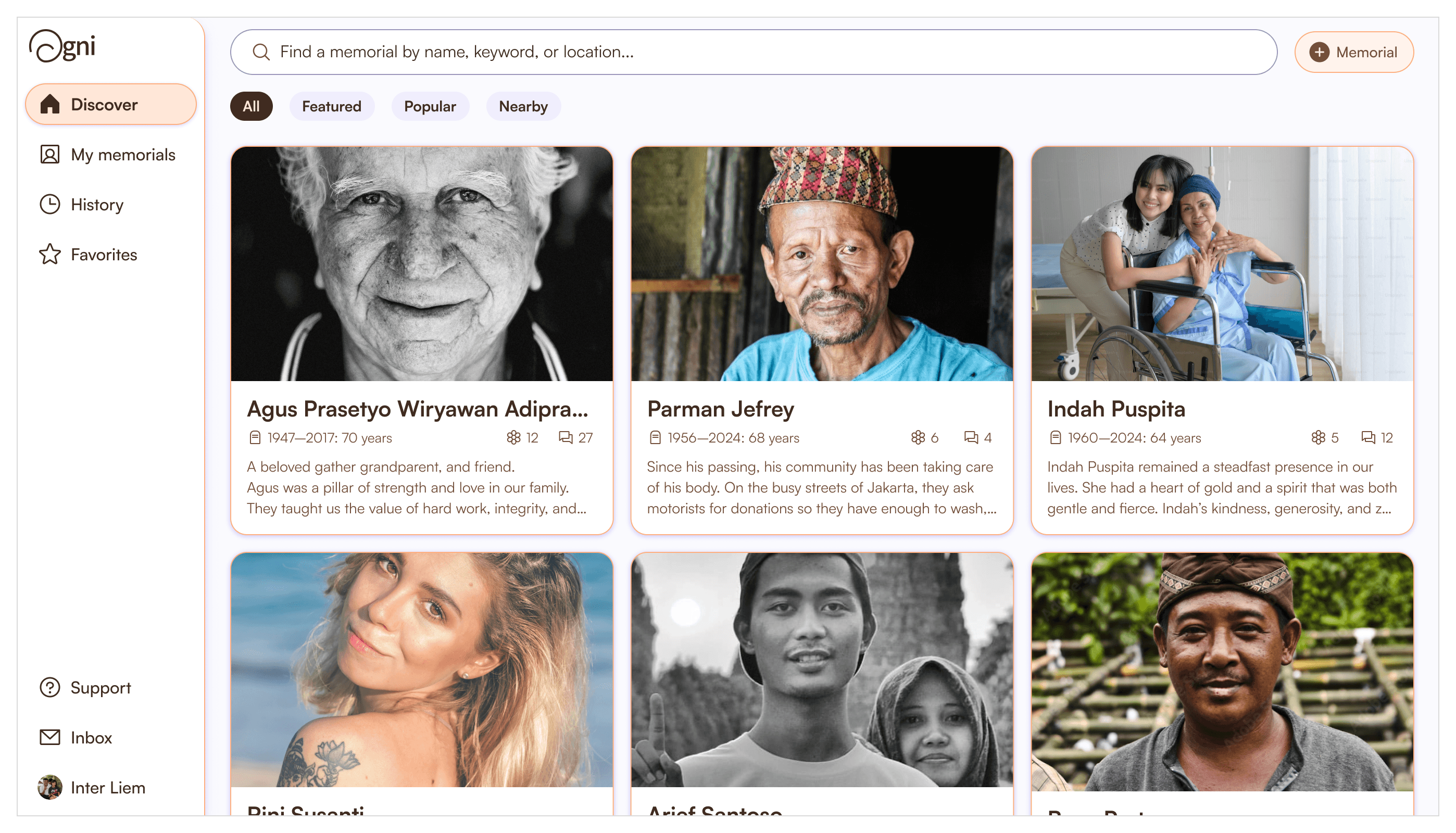
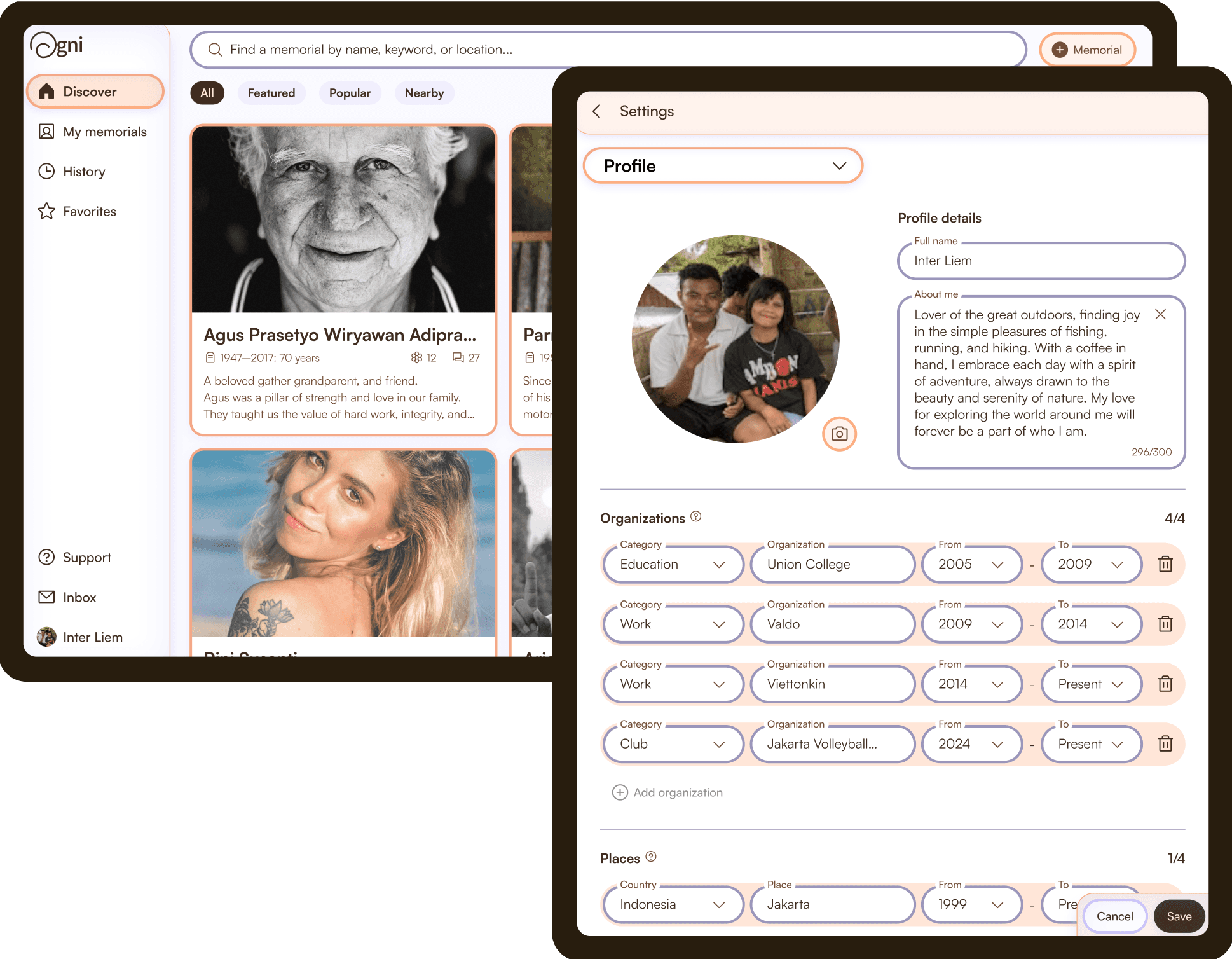
[Discover] A gallery of community-created memorials
We want the [Discover] page to showcase memorials relevant to each user. These memorials would contain attributes like locations the deceased lived in and organizations they were associated with.
By connecting these attributes with details entered in the user’s profile, we can foster a more personalized experience.
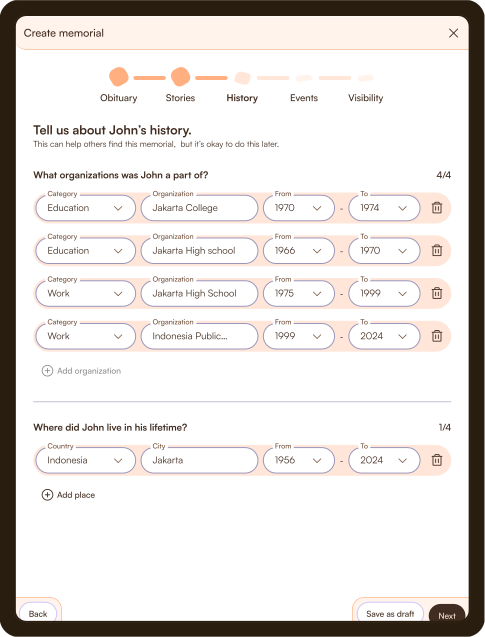
[Create memorial] Adapting the experience for grieving users
We designed the memorial creation wizard to be non-linear, allowing users to skip steps if they’re not ready to complete. We expect memorials to be created during moments of grief, and we want to accommodate for if they need more time, or may want to ask friends or families to help fill out the fields.
To ensure memorials are created under appropriate circumstances and to prevent duplicates, we require the memorial creators to provide key details that Agni admins can use to verify the death.
Initially, we required an copy of the death certificate, but we recognized this would create a barrier for many users, as locating or acquiring the document may not be feasible.
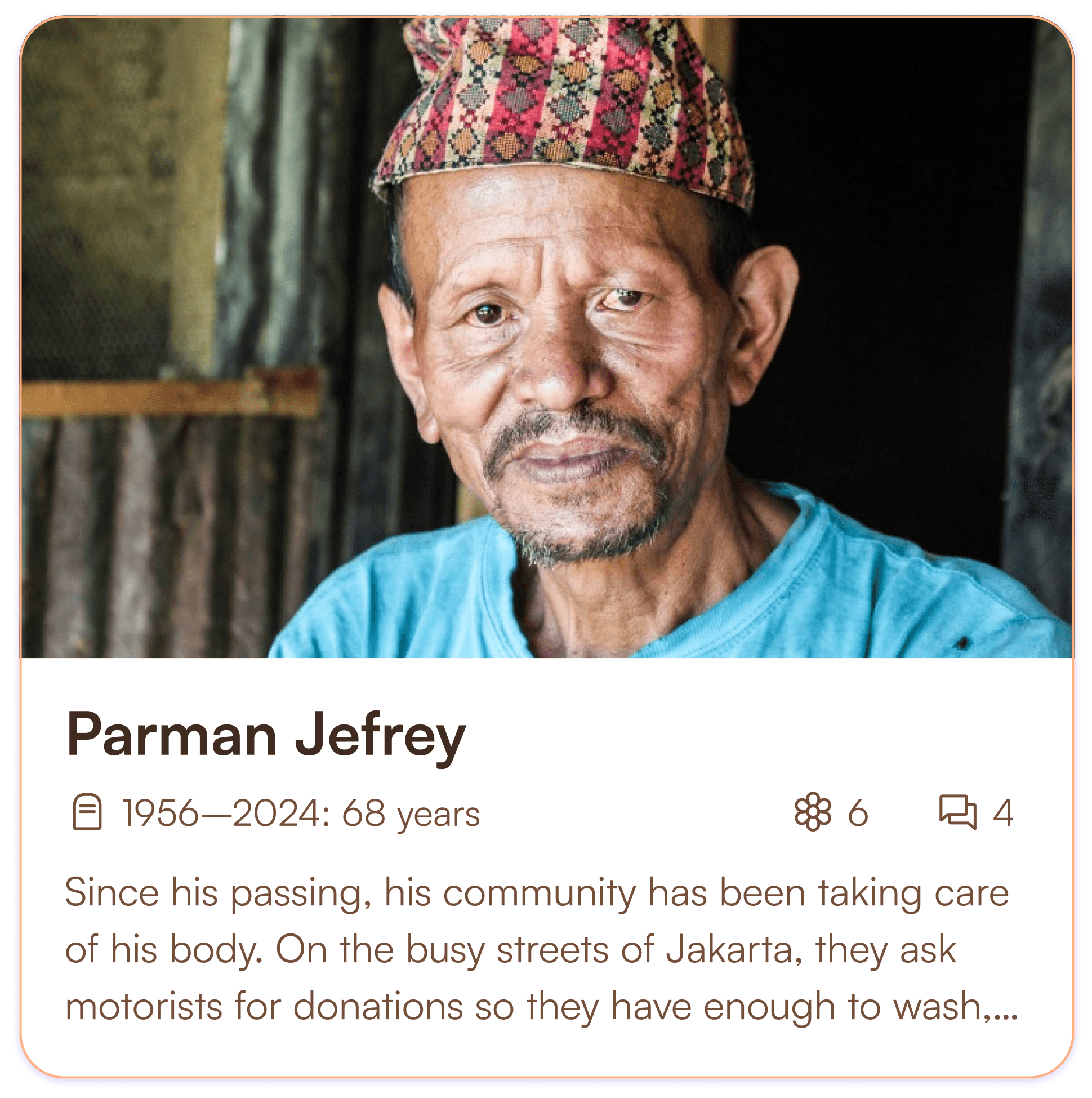
Goals of a memorial card
Memorial cards are designed to be readable and clear, conveying who the memorial is for and encouraging users to explore further.
Image - the focal point because it’s likely be the deceased’s best picture and a point-of-recognition for visitors
Lifespan and age - common on funeral platforms, dates and age help users identify the person
Flower and message - a visible indicator of activity and may encourage users to click and engage with the memorial
Eulogy - a snippet provides preview into the memorial
[My profile] Making impact visible
While we structured profiles to display their contributions on Agni, we also want to make their role in their community known and appreciated. We also explored ways to discourage bad actors, and concluded that showcasing users’ activities would reduce anonymity and ward off nefarious activities.
In respects of private memorial pages, those will not be publicly displayed.
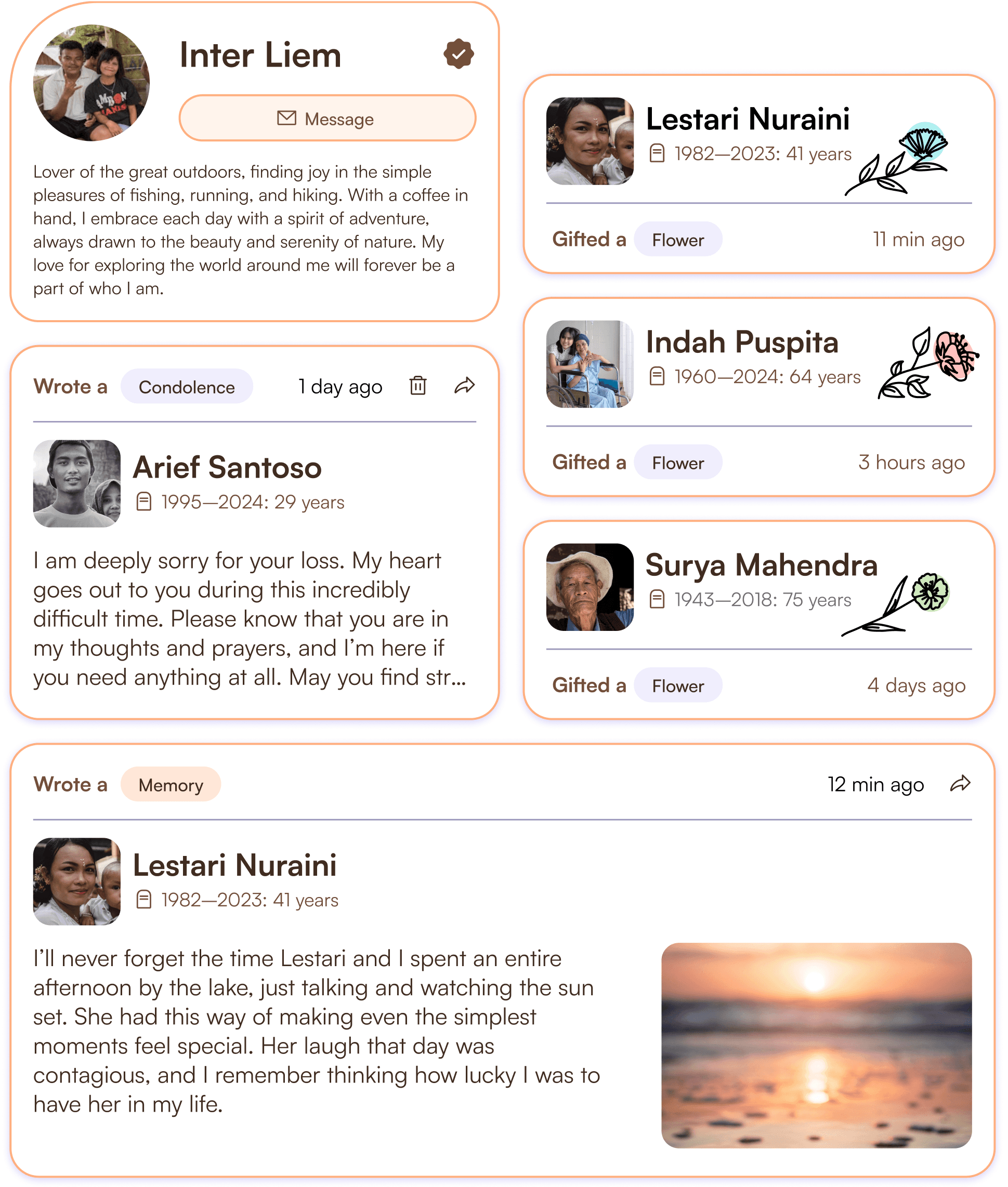
[Gift of sympathy] Not just digital flowers
Our goal is to make each act of remembrance feel intentional and meaningful. We limited how often users can place a gift on a memorial to mirror real-life acts of remembrance. This decision was based on our observations that visitors tend to pay their respects on significant dates like birthdays, anniversaries, or religious holidays. To support this behavior, we would send reminders and encourage revisitation.
Related to gifts are tokens, an in-app currency used to place gifts. With tokens, we want to create a separation from real-time payment decisions and foster a more immersive app experience.

Scaling down
version 2.2; Mvping the MVP
Refocusing
To scale down so we can build, deploy, and test faster, we prioritized features that refine Agni into to its core concept: memorials.
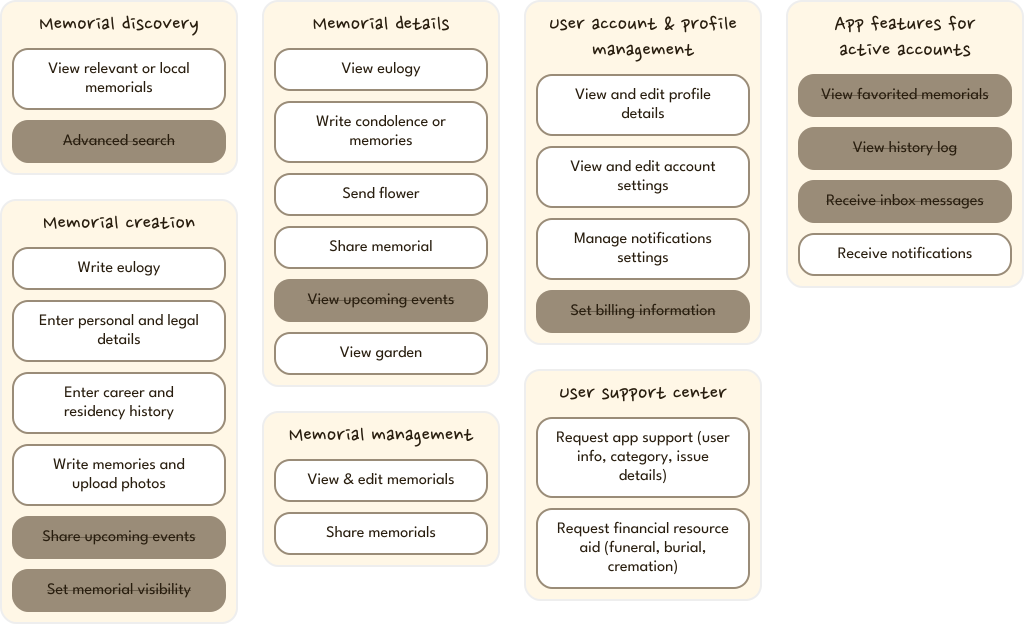
Updated MVP screens
User testing
We didn't conduct testing
Why?
We decided not to simulated user testing due to many resource constraints, and concluded it's best to develop, deploy, and get insight from real-world uses because Agni is an early-stage concept.
What I would've done
Under the pretense of no budget, I would conduct time-conscious moderated and unmoderated tests, and recruit candidates from accessible online communities.
To establish a baseline, I would want to learn about:
their experiences or observations with grief
how has it impacted the and how did they navigated through it
how would they go about remembering someone
When going through the prototype, I would present scenarios and observe them:
creating a memorial for a close relative
looking up a memorial of an old friend
file a request for funeral financial aid
To follow up, I would want to measure:
what do they think this platform is about
likeliness to utilize this platform if applicable
if this experience made them for comforted or uncomfortable, and why
Go-to-marketing
Hello internet!
Our goals
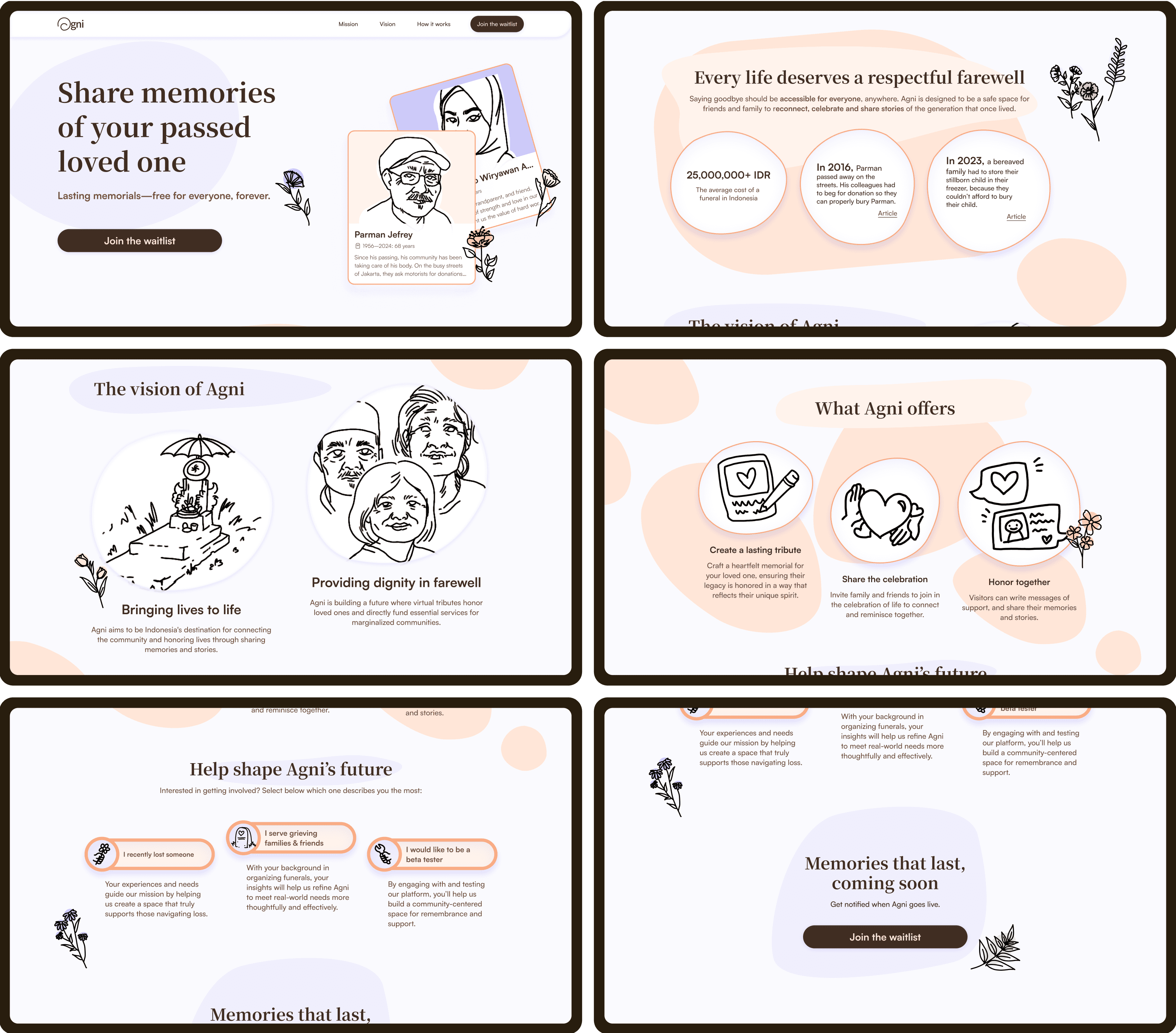
While forming our developer team, we wanted to create a go-to-market page and:
Communicate who Agni is
State Agni’s mission & vision
Start generating interest & market awareness
I did the visual design & copywriting.
Reflections
The end
Lessons and resolutions from my journey
While there’s a few tasks our team can work on as we are seeking volunteer developers, I’ve come to the conclusion that I’m ready to pursue a more challenging role. This project has positively impacted on my growth as a designer, a person, and a team lead immensely, but I crave to be in an environment where I’m continuously challenged by stakeholders, and engaged in navigating between the problem and solution space.
Before I departed, I cleaned up academic and UI documentations, and onboarded our next Design lead.
There’s a lot I can talk about, but here’s a few short takeaways:
Progress is driven by continuous improvement
There is a trade-off for almost every design decision
Navigate pushback through the lens of understanding
Listen to the gut, and probe with questions